Translate

Thursday, October 3, 2013

New Tables for $1/2 Fixed Limit Draw High


To understand the tables, first look at the diagram below. It shows a full table of six players. The first player to act is labelled `5,’ the second player to act `4’ and so forth up to player `0,’ who is in the big blind.    
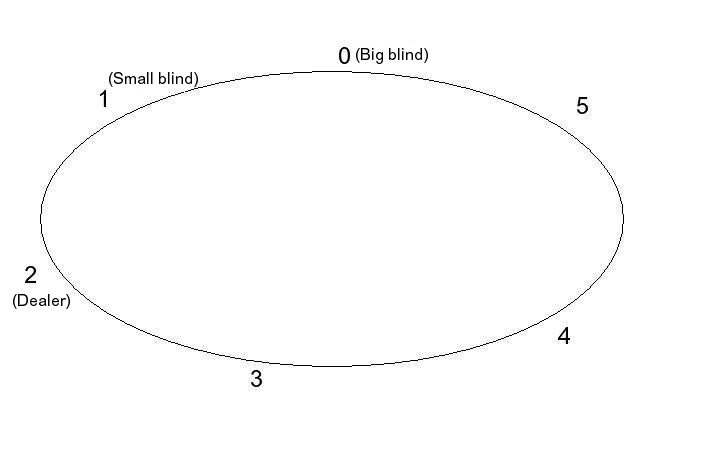

Strategy for the First Round
Opening Requirements

Table 1: What to Open and Raise with
POSITION
OPEN
RAISE
5
QQ
AA
4
JJ
KK
3
99
QQ
2
66
99
1
A
22


Table 1 is the same as the table in my September post.

Calling Requirements

Table 2: Calling against One Opponent who Opens (Bets) $1
Opener’s
Opener’s
Your Position

Position
Worst Hand
5 TO 2
1 TO 0

2 pair
JJ22
9922

AA
3322
AAk

KK
3322
AA
5
QQ
AA
KK
4
JJ
KK
QQ
3
99
QQ
TT
2
77
1010
99
1
44
88
66

Q
AQ high
A high

The hands in Table 2 were computed on the basis that you need a certain chance of winning in a showdown. Position 5 to 2 needs to have a higher chance of winning than position 1 to 0. This is because, in position 5 to 2 you have not contributed to the ante but in position 1 to 0 you have and your contribution is considered to be part of any call you make. If you are up against two players, increase requirements by one notch, for example QQ becomes KK.


Table 3: Calling against One Opponent who Opens (Raises) $2

Opener’s
Opener’s
Your Position


Position
Worst Hand
5 TO 2
1
0

3322
QQ22
JJ22
TT22
5
AA
8822
3322
AAk
4
KK
AAk
AAk
AA
3
QQ
AA
KKa
KKa

JJ
KKa
KK
QQa
2
99
QQ
JJa
TTa

77
JJ
TT
99a
1
44
99
88
77

Q
AK
AQ
A


You must have a slightly better hand in general when calling a raise in round one than when calling a bet, since your pot odds are less. If you are up against two players, increase requirements by one notch, for example QQ becomes KK.

Raising Requirements


Table 4: Raising
Opener’s
Opener’s
Min. Raising
Position
Worst Hand
Hand

AA
JJ22

KK
7722
5
QQ
3322
4
JJ
AA
3
99
KK
2
77
QQ
1
44
JJ

Q
44


Against a single opponent, raise according to Table 4. If there are two players then increase raising requirements up by one notch.


Table 5: Calling against a Re-raiser
Your
Re-raisers Worst
Call On
position
Minimum Hand

5
JJ22
KK22
4
7722
TT22
3
3322
9922
2
KK
AA

Sometimes, when you raise before the draw, someone will re-raise you. In that case, use Table 5. To illustrate, suppose you raised from position 5 and someone re-raises you – to find out whether to call simply look at Table 5, then look at “Your Position” 5, scroll across to “Call On” and you can see that you must not call unless you have at least KK22. This table is most useful when you have limited information.  If you know what kind of hand an opponent frequently re-raises with before the draw, then use that information instead.

Strategy for the Final Round
Betting

Table 6: Betting against a Single Opponent
Worst Hand he Opens With*
Minimum Betting Hand
8822
444
3322
222
AA
KK22
KK
JJ22
QQ
8822
JJ
3322
99
AAk
66
KK
22
JJa
A
99
Q
77

Table 6 shows what hands to bet with after the draw against a single opponent. To illustrate, if you figure your opponent drew three cards to JJ, you should bet after the draw if you make at least 3322, otherwise you should check. If you are second to speak, you may reduce requirements by one notch since the first player shows weakness by checking.  Lastly, if you are up against someone who bluffs more than he should, you may do better by checking even if you have a hand you could bet with and the same is true if your opponent raised before the draw.
*Or better. Example: an entry of KK means you figure your opponent opened on a pair of kings or better.


Table 7: Betting against Multiple Opponents
No. Of Players
Minimum Betting Hand
3
AA22, KK22, or QQ22


Table 7 shows you what to bet on after the draw when you are facing two other players, each of whom you figure drew three cards to a pair. If you draw three cards and are first to act with two other players ahead of you who each drew three cards, bet if you make atleast AA22 or better. If you are second to act, bet KK22 or better. If you are third to act, bet QQ22 or better.


Calling

Table 8: Minimum Calling Hands
Bets in Pot
Opponent’s Min Hand
2
3
4
3322
QQ22
JJ22
TT22
AA
6622
3322
3322
KK
AAk
AAk
AA
QQ
KKa
KKa
KKa
JJ
KKa
QQa
QQa
77
JJ
TT
99a
44
99
88
77
A
33
22
22
When you do not know how your opponent plays, follow Table 8. For someone who bluffs too much, call with any hand that can beat their bluff. For instance, if a player draws three cards to a pair, he should bluff 1-in-every-6 times in this situation. If you catch someone bluffing ¼ or ½ the time in this situation, then they are bluffing too much and you must call with less than Table 8 indicates. 

Raising
Approximate minimum raising hands are already provided in Winning Poker Systems on page 73 and do not require adjustment for Internet play.

Playing Heads-up
Included here is a special section for playing heads-up draw at the $1/2 tables.

Table 9: How to Play Heads-up

Opponent Raises on

Call With
Re-raise With

Fraction
Small blind
Big Blind

TT or better
1 in 4
QQa
QQ
KKa
77 or better
1 in 3
TTa
99a
QQa
22 or better
1 in 2
77a
66
TT
A or better
2 in 3
44
22
77
Anything
1 in 1
Anything
Anything
22

General Strategy
When you are in the small blind, you should call with an Ace high or better and raise with at least 22. If you are in the big blind and the small blind just calls, raise him with a pair of twos or better.
Using Table 9
Of course, part of the time you are going to get raised! In that case, one way to increase your chances of winning is to monitor how often he raises. You can track this during play with a pen and paper by noting how many times he raises relative to the total number of hands played. Look at the `Fraction’ column in Table 9 – if he raises once every two rounds on average (1 in 2), then he probably has at least 22, so you can call with 77a from the small blind and 66 from the big blind. You can raise him with TT or better. Once you know how he plays, try to see his worst starting hand when he raises and make a note of it. Once you’ve got his worst likely raising hand, it is very easy to call correctly: simply note his hand in the left column and call and raise according to the right columns! In the final round, you should bet according to Table 6.

Tuesday, December 13, 2011

Poker Hand Ranges/Combinations

It has been discovered that the system used with the program to create Tables 2, 3, 5, and 9 is slightly off. Hence, please use those tables with caution until fixed. As soon as a fix is done, the tables will be revised appropriately.

However, you can keep using these tables in the first round: Table 1: Opening, and Table 4: Raising. You can also use all of the post-draw tables. These include Table 6: Betting, Table 7: Betting against multiple opponents, and Table 8: Calling.

It should also be noted that Table 4 for raising before the draw has been amended slightly.

Thursday, December 8, 2011

New Draw Tables

I have almost finished the new draw tables and I will post the nine tables here within three days! The first set of tables will be for fixed-limit and soon after I will post the second set for pot-limit. These tables will be more accurate than the last ones. The new tables will also be the `final’ version. In the near future I will make a post explaining how I made some of the tables. An upcoming post will also explain how to take notes on your opponents to use with the charts.  

Sunday, December 4, 2011

Updated Draw Poker Tables!

Updated Draw Poker Tables!
The old draw tables were not 100% perfect; they made you play too tight and in other situations, too loose. You will recall that I used Winning Poker Systems to devise the charts. Books like Super System and Winning Poker Systems are not inaccurate; they are out-of-date. Super System is for Jacks or Better draw and Winning Poker Systems contains charts that are perhaps only approximate. When I used charts from that book therefore, my charts were also approximate. However, the formulas in that book are reliable, so using just the formulas in combination with my new computer software, I can now produce open, calling, and raising tables almost error free! New charts for fixed limit draw and pot limit will be up here in three weeks. They will be much more accurate than the previous charts. Make sure you return and pick up the charts, print them off and use them in your game.

Friday, November 18, 2011

A Strategy for Winning at $1/2 Pot-limit Draw Poker Online

A STRATEGY FOR POT-LIMIT STRAIGHT DRAW POKER

Here you shall find a complete strategy made up of four tables for playing pot-limit draw poker on the Internet, suitable for $1/2 tables.

The Difference in Charts between Fixed Limit and Pot-limit
 In fixed limit, the amount of money you put into the pot is fixed; but in pot-limit the maximum amount of money you can put in is equal to the pot. This means you can bet more. As a result, you must have slightly better hands to open, call, and raise with before the draw since someone can bet or raise more than in fixed. However, by following the charts set forth, you should not commit errors like calling with weak hands or opening wrongly.  Tables P1 to P4 have been computed especially for $1/2 pot limit draw poker as played on the Internet using Zadeh’s book, Winning Poker Systems from 1974. My charts are approximations only – that means they are not 100 per cent accurate and winning is not guaranteed, but your chances of winning may be increased if you follow the charts. To understand the `Position’ numbers, please scroll down to my September post and view the diagram of a poker table.

Strategy for the First Round – Pot Limit
Opening Requirements

Table P1: What to Open and Raise
POSITION
OPEN
RAISE
5
KK
3322
4
QQ
AA
3
TT
KK
2
88
TT
1
22
44


As an example of using Table P1, in 5th position bet $1 if you have at least a pair of Kings and raise $2 with at least two pair: threes and twos. In Table P1 you can see that the hand to open (bet or raise) is one or two notches higher than for fixed limit.
Calling Requirements

Table P2: Calling against One Opponent who Opens (Bets) $1
Opener’s
Opener’s
Your Position

Position
Worst Hand
5 TO 2
1 TO 0

2 pair
JJ22
TT22

AA
4422
3322
5
KK
3322
AA
4
QQ
AA
AA
3
JJ
KK
QQ
2
99
QQ
JJ

77
TT
TT
1
44
99
77

Q
33
22


Table P2 for calling someone who opens (bets) $1 is exactly the same as for fixed limit, except that the column: Opener’s Position has been changed. Only refer to that column when you know nothing about your opponent. Assume he plays well. Therefore, in 5th position he will open (bet) at least KK, so you should call with 3322 in position 5 – 2 but call with only AA in position 1 or 0. Once you know what your opponent opens on, make a note of it and disregard `Opener’s Position’ column; for instance a bad player “opens 77 from pos. 4” might mean he bets $1 with a pair of Sevens before the draw when there are four people left to act. Now you can call him on TT!


Table P3: Calling against One Opponent who Opens (Raises) $2
Opener’s
Opener’s
Your Position

Position
Worst Hand
5 TO 2
1 TO 0
5
2 pair
KK55
JJ33
4
AA
8877
3322
3
KK
3322
3322

QQ
AA
AA
2
JJ
AA
KK

99
QQ
QQ

77
JJ
1010
1
44
99
88

Q
22
22


Once again, Table P3: calling against someone who opens (raises) $2 is the same as for fixed limit, except for opener’s position column. You can use this chart to play effectively against people whom you do not know and also against people whom you have observed. It is intended for use against a single opponent.
However, what if there are two players? What if the first guy raises $2 and another person calls, it is your turn to act – what to do? If you know nothing, call according to the chart but raise the requirement up one notch: QQ becomes KK, 3322 becomes JJ33.
Special: Before the draw, the pot could become bigger than in fixed-limit. For example, the blinds equal $1.5 – if someone bets $2, player 2 could raise to $3.5 making $7 total in pot. To raise the opener, player 2 needs to have a very good hand as Table P4 reveals. Hence, if someone opens and gets raised the pot (limit) expect to be up against KK22 on the average. Against KK22 you need to have at least a 25% chance of winning in a showdown. Therefore, do not call a pot-limit raiser unless you have at least two pair Aces high.

Raising Requirements

Table P4: Raising
Opener’s
Opener’s
Min. Raising
Position*
Worst Hand
Hand

AA
888
5
KK
222
4
QQ
AA55
3
JJ
KK22
2
99
JJ33

77
8877
1
44
3322

Q
QQ

*Assumes the opener has bet.
Table P4: Raising, is the biggest change to fixed limit. The minimum raising hands in the table are computed based on needing an 80% chance of winning in a showdown. If there are two others in the pot and you are considering raising, then increase requirements up one notch (8877 becomes JJ33).

Strategy for the Final Round
The strategy for fixed limit is exactly the same after the draw as for pot-limit. That means, once the first round is over, simply refer to Table 6 for betting and Tables 8 and 9 for calling in my September post. Table 6 betting shows you how to bet after the draw against one or two opponents. Tables 8 and 9 shows you how to call against one opponent depending on the pot odds (that is, the ratio of the `bets in pot’ to the `total pot,’ for example if there is $10 in the pot and it costs $5 to call then there are two bets in pot).  These tables should cover most situations after the draw in pot-limit. Generally, do not raise in pot-limit after the draw unless you have at least QQQ.

How much to bet?
In pot-limit poker, some players will bet more when they have a really good hand and bet less when they have a borderline hand, but if you do this then observant opponents will be able to gauge the strength of your hand just by the way you bet! Alternatively, you could bet the limit always! However, this is not advised as you will probably be over-betting. You must therefore devise your own strategy from which you can bet and raise and still entice others to call with weaker hands – all the while disguising betting habits so as not to tip off opponents.

In Summary
·         Before the draw, bet and raise according to Table P1. If someone bets $1 then call according to Table P2, if instead they raise $2 then call according to Table P3; in both cases, increase requirements by one notch if there are two other players. If someone opens, and another player raises the pot limit, only call if you have AA22 or better.
·         Raise before the draw as per Table P4.
·         For the second round, please refer to Tables 6, 8 and 9 in my previous September post. Since the tables are all over the place, you might find it easiest to copy and print the tables off directly from your web browser or in Excel or even write the tables down on paper by hand.

It is hoped that with these tables you will have a greater chance of winning than you did before. At the very least, you should now have a good idea of approximately how to play with few errors. As you gain experience in pot-limit, you will develop an `instinct’ for when players are betting or raising out of the ordinary, in a way that suggests they are bluffing or unwittingly making basic but blatant calling errors. Remember to take notes on all players. As you play more, you might decide to vary your strategy from the charts – sometimes playing weak, other times playing strong and I will make a forthcoming post about this tactic soon. Hence, bookmark this web site now and check back often! If you have questions, comments or suggestions, then email me at david6779@yahoo.com.

Friday, November 11, 2011

Tables for Pot-Limit Draw

Many of you may enjoy playing pot-limit draw poker online but may not know exactly what hands to open on call or raise with. I have put up a simple poll above that you should fill out. The poll asks whether you want to see tables for pot-limit draw. If you want to see tables then tick “YES”; alternatively, you can click “NO.” In pot-limit draw games, players can bet up to the limit of what is in the pot instead of a fixed amount – this can make games more profitable. If you want to play and win at pot-limit then you will need different tables than the ones I created for fixed limit.